
Loading...
Searching...
No Matches
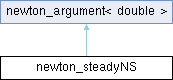
Structure to implement a newton object for a stationary NS problem. More...
#include <ReducedSteadyNS.H>
Public Member Functions | |
| newton_steadyNS (int Nx, int Ny, steadyNS &problem) | |
| int | operator() (const Eigen::VectorXd &x, Eigen::VectorXd &fvec) const |
| int | df (const Eigen::VectorXd &x, Eigen::MatrixXd &fjac) const |
| Public Member Functions inherited from newton_argument< double > | |
| newton_argument () | |
| Constructor. | |
| int | operator() (const Eigen::VectorXd &x, Eigen::VectorXd &fvec) const |
| Operator to compute the residual vector. | |
| int | df (const Eigen::VectorXd &x, Eigen::VectorXd &fvec) const |
| Operator to compute the jacobian matrix. | |
| int | inputs () const |
| Return the inputs. | |
| int | values () const |
| Return the values. | |
Public Attributes | |
| steadyNS * | problem |
| int | Nphi_u |
| int | Nphi_p |
| int | N_BC |
| scalar | nu |
| Eigen::MatrixXd | tauU |
| Eigen::VectorXd | BC |
| Public Attributes inherited from newton_argument< double > | |
| int | m_inputs |
| int | m_values |
Additional Inherited Members | |
| Public Types inherited from newton_argument< double > | |
| enum | |
| typedef double | Scalar |
| typedef Eigen::Matrix< Scalar, InputsAtCompileTime, 1 > | InputType |
| typedef Eigen::Matrix< Scalar, ValuesAtCompileTime, 1 > | ValueType |
| typedef Eigen::Matrix< Scalar, ValuesAtCompileTime, InputsAtCompileTime > | JacobianType |
Structure to implement a newton object for a stationary NS problem.
Definition at line 51 of file ReducedSteadyNS.H.
|
inline |
Definition at line 54 of file ReducedSteadyNS.H.
|
inline |
Definition at line 56 of file ReducedSteadyNS.H.
| int newton_steadyNS::df | ( | const Eigen::VectorXd & | x, |
| Eigen::MatrixXd & | fjac ) const |
Definition at line 128 of file ReducedSteadyNS.C.
| int newton_steadyNS::operator() | ( | const Eigen::VectorXd & | x, |
| Eigen::VectorXd & | fvec ) const |
Definition at line 70 of file ReducedSteadyNS.C.
| Eigen::VectorXd newton_steadyNS::BC |
Definition at line 74 of file ReducedSteadyNS.H.
| int newton_steadyNS::N_BC |
Definition at line 71 of file ReducedSteadyNS.H.
| int newton_steadyNS::Nphi_p |
Definition at line 70 of file ReducedSteadyNS.H.
| int newton_steadyNS::Nphi_u |
Definition at line 69 of file ReducedSteadyNS.H.
| scalar newton_steadyNS::nu |
Definition at line 72 of file ReducedSteadyNS.H.
| steadyNS* newton_steadyNS::problem |
Definition at line 68 of file ReducedSteadyNS.H.
| Eigen::MatrixXd newton_steadyNS::tauU |
Definition at line 73 of file ReducedSteadyNS.H.
 1.16.1